Deep Python tutorials plus Docker, Git, Kubernetes, AWS, and more — quizzes, challenges, and tools in one place.
class PythonDeveloper:
def __init__(self, name):
self.name = name
self.skills = []
self.certificates = []
def learn(self, topic):
self.skills.append(topic)
return f"✅ Learned {topic}!"
def get_certified(self):
self.certificates.append("🏆")
return "Certified!"
dev = PythonDeveloper("You")
print(dev.learn("FastAPI"))|
0+
Tutorial lessons (catalog)
0+
Practice quiz questions
0K+
Certificates earned
0K+
Learners in the community
Structured lesson paths — Python, delivery, data, and more
Tutorial tracks appear here when published. Staff can seed content or author lessons in the console.
Open tutorials hubData Structures & Algorithms — solved in Python
Python, cloud, DevOps, and more — test your knowledge
Solve real problems, earn points, climb the ranks
Given a grid of slashes, count the number of connected regions formed by the slashes and the grid borders.
Given a string and a number k, find the length of the longest substring that can be made uniform by replacing at most k characters.
Implement a function that uses a non-greedy regex to extract the shortest substring between two delimiters.
Simulate a number guessing game with attempts, feedback, and a win/lose result.
Write a function that compresses a string by replacing runs of identical characters with the character followed by the count.
Implement a function that converts a simple text table into a list of dictionaries.
Implement a variadic function that sums an arbitrary number of numeric arguments.
Write a function that returns True if a number is perfect, i.e., equal to the sum of its proper divisors.
Write a function that horizontally concatenates two 2D lists into a new 2D list.
Implement a function that returns the elements of a 2D matrix in clockwise spiral order.
Write hex_encode and hex_decode to convert between hex strings and integer byte values.
Minimize the largest sum among k contiguous subarrays using dynamic programming.
Copy-ready snippets — study, paste, and run in the browser IDE
Python IDE
A full in-browser workspace: edit with syntax highlighting, run code with Pyodide, peek at stdout and stderr, and tidy with PEP 8 formatting — no install required.
# PythonSkillset IDE
def greet(name):
return f"Hello, {name}!"
print(greet("world"))
Illustration only — open the IDE for the real thing.
Code formatter
Paste messy code into a split editor, pick line length, and format with autopep8 on the server — then copy the result.
def calculate( x,y ):
result=x+y
if result>10:
print( "Big!" )
else:
print( "Small" )
return result
def calculate(x, y):
result = x + y
if result > 10:
print("Big!")
else:
print("Small")
return result
Illustration only — open the formatter to use your own code.
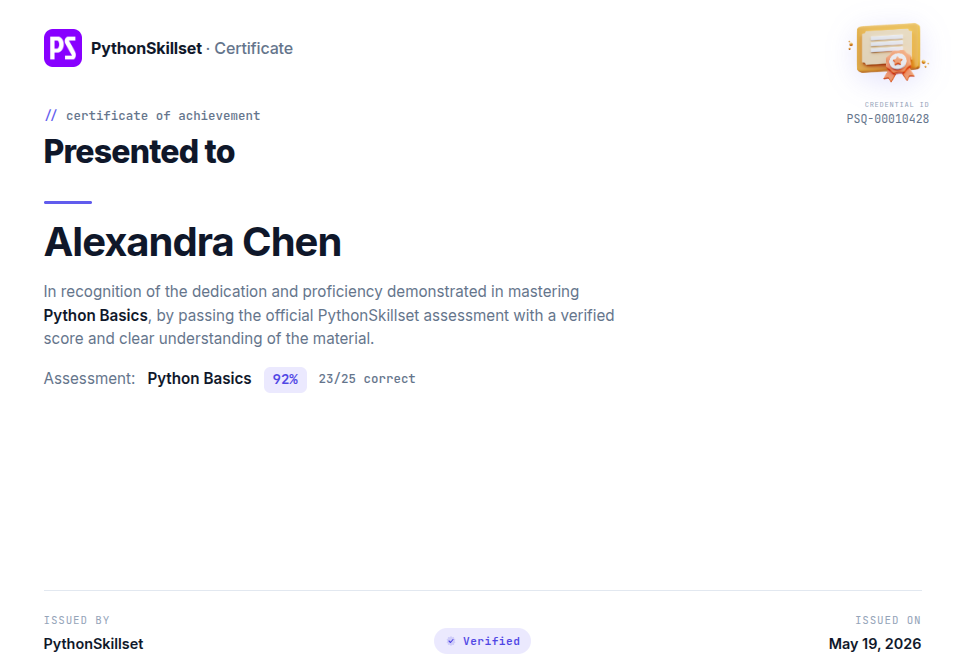
Pass any quiz at 80% or higher and receive a polished, shareable certificate — PDF download and print-ready HTML.
Sample certificate · click to open
This certificate is for course completion only and holds no academic or professional accreditation. See Terms of Use and Privacy Policy.
Top Python developers this month
Sarah Kim
Level 12
Raj Patel
Level 10
Lisa Chen
Level 9
Alex Johnson
87 challenges
Priya Sharma
72 challenges
Carlos Ruiz
65 challenges
Languages, tools, and notes worth keeping — sorted by topic with runnable examples when they help.
Explore why Python's standard json module lags behind orjson and ujson in speed and memory. Learn the core optimization principles and when to choose the right parser for …
An argument for a unified, modern CLI framework in Python's standard library, highlighting the costs of …
PythonExplore the real reasons Python runs slower than compiled languages—interpreter overhead, dynamic typing, and the GIL—and …
Cheat sheets, references, quizzes, and the full resource library